Roles and Groups

Zone des éléments

Référentiel

Code

Note(s) sur la portée et contenu

    Note(s) sur la source

      Note(s) d'affichage

        Termes hiérarchiques

        Roles and Groups

        Termes équivalents

        Roles and Groups

          Termes associés

          Roles and Groups

            581 Description archivistique résultats pour Roles and Groups

            GB 2014 WS-05-ELM-02-5-21 · Pièce · 1793-10-22
            Fait partie de Westminster School's Archive and Collections

            Oxford. Continuation of account of travels. From Carlisle to Penrith, and then on foot with a guide to Kendal and the Lakes. Ullswater and Patterdale - the king of Patterdale a great miser (who in fact died 5 days after the writing of this letter). The next to the top of Helvellyn, and on to Keswick. 2 days at Keswick, and 2 more at Windermere. Lovely country (as also in Scotland), but PE has realized that works of art give him more pleasure than those of nature. The docks of Liverpool delight him more than any landscape. 2 days in Liverpool with friends of Veysie (population of 70,000, doubled over last 30 years). Chester and on - but no need to describe this, since sister-in-law has seen it. A week in Worcester with Philpott (excursions to Hereford and Gloucester). Tewkesbury and Cheltenham (where a day with the Beverleys). Probably the best summer of his life - now for 10 months of noise, smoke, filth and confinement.

            GB 2014 WS-05-ELM-02-5-25 · Pièce · 1818-07-10
            Fait partie de Westminster School's Archive and Collections

            From John Vaughan, concerning the payment of some drafts from John (her late husband?) - he prefers that they not be paid at Ealing. A ship in dock has two pieces of canton crepe from a Mr Boylston, but they cannot be brought ashore except at the risk of the ship being seized - he will ask if it might be possible to pay duty and import them, and asks her to destroy this letter.

            GB 2014 WS-05-ELM-02-5-28 · Pièce · 1814-07-12
            Fait partie de Westminster School's Archive and Collections

            Paris. Apologises for delay in writing, but the journey was long. Slept at Blossom's Inn, Lawrence Lane, (and hopes never again), at Brighton, then at Dieppe - description of route to Paris and of scenery. (Le) Havre centre of French West India trade and full of bustle. Rouen ugly but prosperous - to theatre in evening (as large as Covent Garden before it was rebuilt, for a town of 80-90,000 inhabitants). Countryside from Rouen to Paris ugly and ill-cultivated. Paris better to live in but worse to visit than he expected. Apparently staying temporarily with Barrois (with whome he travelled as far as Rouen) - he has an excellent house and a well-educated wife, who speaks English and understands Latin. The French are a cleanly people, but there is a general air of shabbiness, perhaps caused by the circumstances of the times - few gentlemen, and it is hard to distinguish an officer from a common soldier. Every shoe black has a mild and polite demeanour - one of the most striking things. Many streets have two names - pre- and post-revolutionary (e.g. Quai Voltaire where Barrois lives is also Quai des Theatins).

            Mary Hallowell to Peter Elmsley
            GB 2014 WS-05-ELM-02-5-29 · Pièce · 1820-07-12
            Fait partie de Westminster School's Archive and Collections

            Thanks PE for letter from Florence dated 10th June. . Expressions of tender feelings from all of them. Mary has had a return of her headaches - would be cured sooner if she were more sedate. Nancy (Ann) is in good health, but not happy at being urged to go into company - sister-in-law is rather happy that she is not charmed by the gaieties which delight other young people. She hears universally good reports of John. PE has talked of a visit to Paris the following year, and Mary is afraid that he might meet a French woman and marry her. Has temporarily started taking a daily paper, because of a scandal involving a lady bidding open defiance to all the accusations against her. News of various friends. Her nephew Ben Hallowell is to leave Charterhouse for Trinity College Cambridge. Her brother is rightly concerned - 7 children, and not one provided for. A friend (Mrs G) is facing two charges - her enemies are perjuring themselves. Has had an accident, and fears she will always have a limp.

            GB 2014 WS-05-ELM-02-5-30 · Pièce · 1816-05-19
            Fait partie de Westminster School's Archive and Collections

            Ostend. Thursday night at Golden Cross, Charing Cross - room facing street, so no sleep. Dover coach at 6am 0 took 14 rather than advertised 11 hours. A female fellow traveller going to Paris to see plays - did not understand French, and did not realise that Parisian plays would be in French. A French lady in the coach was as ugly and as agreeable as sin. Met the master of a small vessel on Friday evening, and set sail for Ostend at 1.00 on Saturday morning - very seasick. Landed at 6.00 on Sunday morning. Must stay in Ostend until the following day, because 4/5 days ago the government (NB which?) made a passport necessary for onward travel. Did not wish to eat shrimps and drink gin in alehouses, so went to mass and vespers. Description of food prices. Tomorrow to Bruges. Please keep his letters, as he does not keep a journal and would like to read them on his return.

            GB 2014 WS-05-ELM-02-5-31 · Pièce · 1816-05-21
            Fait partie de Westminster School's Archive and Collections

            Bruges. Took all Monday morning to get passport - then to Bruges by barge. Country flat and dull - willows, poplars, windmills, churches, cows. Staying at the Cornflower Inn. Bruges lovely and old - stalls of the Knights of the Golden Fleece in the cathedral. Streets very twisty, so easy to lose sense of direction - but the bells of the town hall help. Does not warm to the inhabitants. Long walk in morning, table d'hote at 1.00 - 1st course 20 types of boiled fish, 2nd course 20 types of fried fish. PE no fish eater, so unlucky that there are 3 rogation days this week (plus Friday and Saturday). Tomorrow to Ghent, and then Brussels. Postscript on separate sheet. Bruges fair - gingerbread stalls, puppet shows and cutlery and linen and woollen goods for sale. Encloses card of inn containing an image of the street. Jesuit college converted to cavalry barracks - the cavalry swagger as in England. Many graven images.

            GB 2014 WS-05-ELM-02-5-39 · Pièce · 1816-07-18
            Fait partie de Westminster School's Archive and Collections

            Rotterdam. Changed boats at Delft en route from The Hague (leaning tower, and beggars). Description of the two-cabined horse-drawn schuit (canal boat). Erasmus statue, with Dutch verses (not Latin, which Johnson would have preferred). The Meuse, and elms on the Boompjes quay - canals in Dutch towns heavily bordered by trees. Rotterdam canals not stagnant, and deep enough for large trade vessels. A young friend of Gaisford's will take all 32 pages to the post in London (beginning Antwerp, 27th June) - PE looks forward to reading them again. To service in Cathedral Church of St Laurence - monument to the English youth Chute.

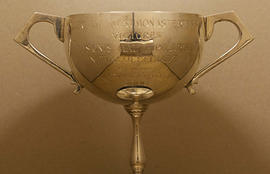
            Croquet Trophy
            GB 2014 WS-04-TRO-001/120 · Pièce · 1911
            Fait partie de Westminster School's Archive and Collections

            Purchased by Eddie Smith and is owned by the Common Room at Westminster School. The trophy is given to the winners of the croquet match between the School and Westminster Abbey and is kept by the winners for a year. The inscriptions are: 'Collegium Westmonasteriensium Victores Lusionis Malleipilaris Intracollegiatae ex dono Sanctuarii Curatoris 2006' and '2006 Abbatia', '2007 Schola', '2008 Abbatia', '2009 Schola'. The School retained the trophy in 2010 but, at time of cataloguing (12 October 2010), this had yet to be engraved.

            John Corsellis
            GB 2014 WS-02-ORA-010 · Pièce · 2013-07-11
            Fait partie de Westminster School's Archive and Collections

            [00:24] Background. Father was barrister, served in First World War and keen pilot; died flying in 1930. Two older sisters, went to Francis Holland. Brother to Winchester. Corsellis to Westminster. [04:14] Prep School at St. Clare’s, Walmar, Kent. About 40 boys. Taught Latin and Greek. Encouraged to try for Westminster. Timid and nervous. [05:48] Put in for the Challenge a year early and failed, tried again and failed and admitted as Town Boy as a Homeboarder. [07:01] Head boy of St. Clare’s. Reading lesson in Chapel – good training in public speaking. Disciplinary authorities and responsibilities. [08:13] Went from ‘big fish’ at Prep School to ‘lowest of the low’ at Public School. [08:24] Joined Westminster September 1936. [08:38] Two uncles had been to Westminster. In awe of the school. [09:35] Friendly school. Proud of Westminster School. [10:02] Started at Westminster living at the northern end of Baker Street. Walk to school in top hat and tail coat through the parks. Enjoyed the attention. [11:12] Family moved to Brighton. Commuted for a term on a daily basis. [11:44] Didn’t enjoy football or cricket matches at Prep School. Became a scorer – went with first XI to away matches, got to enjoy the food, ‘felt nice and important’. [12:38] Westminster offered fencing instead. ‘Tiny claim to fame at Westminster’ with fencing. Clerihew ‘Corsellis / rhymes with trellis / Hence / Fence’. [15:30] Fencing in Little Dean’s Yard when weather was nice. Fenced over the graves of the monks in the cloisters. Old Gym when the weather was bad. Armory garden, Ashburnham Garden? [17:14] Distinguished French fencing instructor. No electric scoring. Didn’t have to do football, cricket or water for fencing. [18:40] Left-handed. Was made to write right-handed. Disorientates right-handed fencers used to fighting right-fencers. Successful. Made school team. Public Schools Championship – first in foils, second in épée. [20:30] Beginning of first term, new intake congregate in Yard and addressed by master in charge of Corps. Gave patriotic speech. Alternatives – Scouts or gym. [22:15] Influence of brother. ‘Mildly disrespectful of authority’, advised not to do Corps. Opted for Gym. Learning to vault and parallel bars. [23:40] Conscious of war. Pacifist tendencies. Aunt ‘militant pacifist’, role model. [25:25] Westminster ‘evangelical, in the wider sense’. John Christie, Head Master, as ‘striking preacher’. Classics Master as pacifist, left school when the war started, ‘presence not very desirable’. Not characteristic of a normally tolerant Westminster. [27:45] Three contemporaries from College joined Friend’s Ambulance Unit (FAU). William Barnes; nickname ‘Bishop’, strong personality but liked and respected, became head boy. [29:57] Norman John Peppin Brown; became Professor of Philosophy in Canada; Catholic. [31:00] Donald Swann; musical, same election as Corsellis, went to Oxford. [31:38] Left Westminster, entered into articles with a lawyer in Oxford. Apprentice, didn’t need a degree. ‘Paid for the privilege of being a trainee in a lawyer’s firm’. One or two years of part time lectures at university. [33:24] Would meet up with Swann while both in Oxford, in British Restaurant for ‘awful meals, quite cheaply’, or two own sandwiches. Got to know Swann’s father, grew up in Russia until the revolution. [36:58] Advise Swann of FAU. Both ended in the same camp in the Cadbury Estate in Birmingham, six weeks of training. Converted stables for recruits, help to toughen up. [38:52] Both sent to ‘training hospital’ Guy’s Hospital in Orpington. Had been Canadian military hospital in First World War, ‘geriatrics hospital’ between wars. Converted to sector hospital to move patients out of London. Swann, Bill Mann (ended up music critic of the Times), Douglas Harvey. [41:08] Hospital porters, used as ward orderlies.